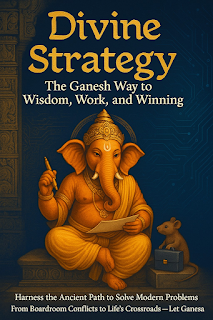
Chapter 21: Content preface, Acknowledgment & References

Subheading: Reflecting, Thanking, and Crediting the
Path of Wisdom
Chapter Outline
1. The Elephant-Headed Strategies: Understanding Ganesha Beyond Myth
An introduction to Lord Ganesha as a symbol of strategic wisdom, leadership,
and problem-solving—transcending religious boundaries to offer timeless
management principles.
2. Buddhi Before Siddhi: The Ethos of Smart Leadership
Emphasizing the importance of intellect before success. A lesson in
decision-making, foresight, and visionary leadership drawn from Ganesha’s bond
with Goddess Buddhi.
3. The Tusk and the Truth: Sacrificing for a Greater Vision
How symbolic self-sacrifice, integrity, and resilience define ethical
leadership—parallels with real-world dilemmas in corporate and social life.
4. Circling the Universe: Focus, Prioritization, and Innovation —
The Wisdom of Ganesha
The story of Ganesha circling his parents as his universe teaches the power of
clarity, priority-setting, and thinking beyond conventions.
5. Modaks and Milestones: Celebrating Small Wins the Ganesha Way
Learning from Ganesha’s love for modaks—the significance of rewarding progress
and celebrating milestones to maintain motivation and team morale.
6. Vighnaharta: Managing Crisis with Calm — The Ganesha Way
Strategies for conflict resolution and crisis management, inspired by Ganesha’s
role as the remover of obstacles.
7. The Mouse and the Mind: Lord Ganesha’s Guide to Mental Mastery
A deep dive into mastering desires, thoughts, and the subconscious mind—lessons
from Ganesha’s symbolic vahana.
8. Listening Ears, Sharp Eyes: The Art of Empathetic Leadership
Drawing lessons from Ganesha’s physical form—how leaders must observe keenly,
listen deeply, and act wisely.
9. Ganesha, Ink, and Analytics: Sacred Data and Strategic
Decision-Making
From writing the Mahabharata to decoding modern analytics—merging ancient
insight with data-driven management.
10. The Broken Tusk and the Whole Truth: Balancing Ethics and Profit
the Ganesha Way
Ethical dilemmas and responsible business leadership inspired by Ganesha’s
iconic broken tusk.
11. The Ganesha Code: Harmonizing Intuition, Insight, and
Intelligence
Developing holistic decision-making that blends spiritual intelligence with
strategic thinking.
12. Ganesha and Global Vision: Expanding Beyond Borders
How Ganesha symbolizes cross-cultural adaptability and visionary thinking for
international growth and diplomacy.
13. Ganesha and the Innovation Mindset: Rethinking Research and
Development
Encouraging curiosity, creativity, and continuous innovation through the lens
of Ganesha's problem-solving stories.
14. Ganesha and Market Resonance: Orchestrating Impactful Events
Learning the art of event management, brand activation, and connecting
emotionally with audiences through cultural symbolism.
15. The 11 Ps of Marketing Thought: The Wisdom of Lord Ganesha
A redefined and spiritualized version of the traditional marketing mix, drawing
from the multifaceted persona of Ganesha.
16. Managing People and Communication the Ganesha Way
Ganesha as a guru of human resource management—navigating conflict, fostering
teamwork, and effective communication.
17. Crafting Brand Positioning: The Ganesha Strategy
Brand identity, storytelling, and unique positioning strategies inspired by
Ganesha's attributes and recognition.
18. Literature Review: Bridging Dharma and Corporate Wisdom
Review of classical scriptures and modern management theories—creating a
confluence between Eastern spirituality and Western strategy.
19. Data Analysis and Interpretation: The Modern OM in Action
Quantitative and qualitative approaches to decision-making in management using
modern statistical tools under Ganesha’s guidance.
20. Conclusions and Limitations: Applying the Ganesha Way in Real
Life
Actionable insights, real-world applicability, and boundaries of divine
strategy in contemporary leadership and learning.
21. Content Outline,
Acknowledgements, and References
A roadmap to the book’s architecture, expression of gratitude, and a
comprehensive list of scholarly and scriptural references.
📘 Preface
In a world filled with rapid change, ethical dilemmas, and intense
competition, we often turn to modern strategies and complex models to find
answers. Yet, ancient wisdom—deeply rooted in stories and symbols—holds
timeless solutions. Among the most revered symbols of wisdom and
problem-solving in Indian tradition stands Lord Ganesha.
This book is not a religious treatise. It is a strategic handbook. It
invites students, educators, professionals, leaders, and seekers to look beyond
myth and understand Ganesha as a timeless management guru—a symbol of
intellect, discipline, and creative resolution.
“Divine Strategy” emerged from my classroom experiences, interactions with
students, and my inner quest to connect spirituality with leadership. Every
chapter builds a bridge between sacred symbolism and modern-day organizational
and personal challenges.
May Ganesha’s grace guide your journey through this book—and through life’s
many crossroads.
Dr. Mamta Vyas
Ex Principal, Educator, Lifelong Learner
Acknowledgment
This book is the outcome of constant
encouragement, spiritual inspiration, and academic mentorship — a journey I
could not have completed alone. I extend my deepest gratitude to every
individual who has contributed, directly or indirectly, to its realization.
First and
foremost, I offer my heartfelt thanks to my beloved mother and all my family members. Their unwavering love, silent sacrifices,
and moral support have been the foundation of my strength. Without their
patience and belief in me, this work would have remained a distant dream.
I am profoundly grateful to my esteemed mentors
— Dr. R.D. Pathak, Dr. P.N. Mishra, and Dr. Rajiv Gupta — whose guidance,
encouragement, and intellectual direction shaped the structure and spirit of
this book. Their blessings illuminated my academic journey and gave shape to my
scattered thoughts.
I offer respectful homage to the great souls
who are no longer with us but whose presence continues to guide me — Dr. O.S. Gupta and Dr. K. Santaram. Their timeless wisdom
moved me from darkness to light and instilled the courage to express with
conviction and authenticity.
My sincere thanks go to my colleagues across various colleges,
whose constructive feedback, professional camaraderie, and shared discussions
enriched this work intellectually and emotionally.
To my dear
friends and extended family, thank you for your constant words of encouragement
and belief in my capabilities. Your kindness — in thoughts, words, and actions
— has been deeply meaningful and motivating throughout this journey.
This book is not merely a personal
achievement, but a collective reflection
of the people, values, and blessings that have shaped me. I dedicate this work
to all of you — my teachers, family, friends, and mentors — with humility and
gratitude.
References
A.
Scriptural and Spiritual Sources
- Shiva Purana
— Translations and commentaries on Lord Ganesha’s birth and wisdom.
- Ganapati Atharvashirsha — Sacred hymn dedicated to Lord Ganesha, source of
symbolic interpretation.
- Bhagavad Gita
— Ethical and strategic wisdom referenced throughout for dharma and
leadership.
- Upanishads
— Select ideas on self-realization and mental discipline (esp. Mandukya
Upanishad on OM).
- Ramayana
and Mahabharata — Story references for spiritual leadership,
including Ganesha and Vyasa’s story.
- Skanda Purana
— Textual support for Ganesha’s festival rituals and public engagement.
- Yoga Sutras of Patanjali — Concepts of concentration, focus, and
self-discipline.
B.
Management & Strategy Books
- Drucker, Peter F. — The Effective Executive
- Covey, Stephen R. — The 7 Habits of Highly Effective
People
- Prahalad, C.K. — The Fortune at the Bottom of the
Pyramid
- Collins, Jim — Good to Great
- Mintzberg, Henry — Strategy Safari
- Kotler, Philip & Keller, Kevin — Marketing
Management
- Barney, Jay B. — Gaining and Sustaining Competitive
Advantage
- Goleman, Daniel — Emotional Intelligence
- Maxwell, John C. — The 21 Irrefutable Laws of
Leadership
- Pink, Daniel — Drive: The Surprising Truth About
What Motivates Us
C.
Journals and Academic Sources
- Journal of Business Ethics – Spirituality in leadership, purpose-driven strategy.
- Harvard Business Review – Case insights on innovation, team building, and
crisis management.
- MIT Sloan Management Review – Analytics, AI, and digital transformation.
- Indian Journal of Management – Local business philosophy and case development.
- International Journal of Cross Cultural Management – Leadership styles and spiritual branding.
- Asian Journal of Management Cases – Indian corporate and entrepreneurial case studies.
D.
Case & Industry Resources (Online & Institutional)
- Infosys – Official website and white papers.
- Tata Group – Case studies from Tata Trusts, TISS, and
CSR reports.
- Reliance Industries – Market strategies, Reliance
Retail insights.
- Netflix & Unilever – Brand positioning, AI/data
strategy (via McKinsey, BCG reports).
- Ministry of Corporate Affairs (India) – Guidelines on
corporate social responsibility and ethics.
- World Economic Forum – Insights on spiritual
intelligence and future leadership.
- YourStory.in – Startup profiles for Indian
entrepreneurs (used in Ganesha + Entrepreneurship chapter).
- Times of India, The Hindu, Business Standard – For
cultural/business event references (e.g. Ganesh Utsav marketing).
E.
Websites and Digital Libraries
- https://www.sacred-texts.com – Translations
of Puranas and Vedas
- https://www.hindupedia.com – Information on
Ganesha’s iconography and stories
- https://www.businessmodelnavigator.com
– For business model design frameworks
- https://www.tableau.com – Dashboard tools
referenced in Data Analysis chapter
- https://www.researchgate.net – Research
papers on spiritual leadership


No comments:
Post a Comment